
Beyond RWA Tokenisation: From Issuance to Collateral, Repo and Settlement


Key points
Institutional digital assets are moving beyond token issuance toward the layers that make tokenised assets usable in financial markets: custody, collateral, financing, repo, digital cash and settlement.
In August 2026, four Mitsubishi UFJ Financial Group (MUFG) companies launched a proof-of-concept for on-chain Japanese government bond (JGB) repo on Canton Network, with Digital Asset Holdings, Progmat and Secured Finance AG. The model preserves the legal status of JGBs as book-entry transfer bonds rather than replacing it.
The legal and documentation layer is developing alongside the technology. ICMA's Digital Assets Annex (2024) and Digital Bonds Annex (April 2026) to the Global Master Repurchase Agreement, and the 2026 extension of legal-opinion coverage to eight jurisdictions including Hong Kong, are the clearest signals of institutional readiness.
The next competitive frontier is institutional usability: whether the asset can be held, financed, pledged, settled and enforced within regulated financial-market infrastructure.
Tokenisation was never supposed to end with the token
The institutional digital-asset market has spent several years proving that bonds, funds, real estate and other traditional assets can be represented using blockchain infrastructure.
That is an important first step.
But an asset does not become part of a functioning capital market merely because it has been tokenised. It must also be capable of being financed, traded, pledged or transferred as collateral, settled, valued, governed, and integrated with cash and other financial-market infrastructure.
This is why the most significant developments in institutional digital assets are now occurring around the token rather than in the token itself.
RWA is useful shorthand, but institutional precision matters
In digital-asset markets, "real-world assets" or RWA is often used as an umbrella term for tokenised bonds, funds, real estate, commodities and other off-chain or traditional assets. For institutional structuring, that shorthand can conceal important distinctions. A tokenised traditional security, a natively issued digital bond and an asset-backed token may all use distributed-ledger technology, but they can represent different legal rights, ownership records, transfer mechanics and regulatory consequences.
ICMA's separate Digital Assets Annex and Digital Bonds Annex to the Global Master Repurchase Agreement illustrate the point. The former addresses digital cash, digital securities including tokenised traditional securities and asset-backed digital assets; the latter extends the framework to natively issued digital debt securities whose terms envisage the use of distributed-ledger technology. For institutions, the relevant question is therefore not merely what has been tokenised, but what legal right exists, where the authoritative record sits, and how that right interacts with financing, collateral and settlement.
From digitising assets to making them financially useful
Much of the first institutional blockchain cycle focused on issuance. Financial institutions explored security tokens, tokenised bonds, digital funds and tokenised real-world assets. That cycle answered one question: can existing financial assets be represented and administered through distributed-ledger infrastructure? Increasingly, the answer is yes.
The harder question is what happens next. A bond that can be held digitally but cannot easily be financed has limited utility. A tokenised fund that cannot be used as collateral remains disconnected from broader liquidity markets. A digital security that cannot settle efficiently against cash still inherits substantial friction from traditional financial infrastructure.
Institutional adoption therefore requires something closer to a full capital-markets stack:
issuance → custody → trading → financing → collateral → settlement → reporting → risk management
The build-out of those layers is now visible in real-value pilots and production systems rather than only in whitepapers.
Collateral is where tokenisation moves from representation to financing
Collateral is one of the foundations of modern finance. Banks, broker-dealers, funds and other financial institutions continually use high-quality assets to secure borrowing, meet margin requirements and manage liquidity.
Government bonds matter disproportionately here because they are highly liquid and widely accepted. The International Capital Market Association ("ICMA") estimates that government bond collateral accounts for over 90% of EU-originated repo collateral. ICMA's 50th European Repo Market Survey, published on 26 March 2026, measured outstanding repo and reverse repo across 59 participants at EUR 13.7 trillion, a figure that grew 24.6% year-on-year.
That is the scale of the market that tokenised collateral and tokenised securities are being designed to interact with. If tokenisation can make high-quality collateral more mobile, more programmable and available across a wider settlement window, the benefit goes beyond administrative efficiency. It affects how capital itself is deployed.
Repo is a natural institutional blockchain use case
Repurchase agreements connect securities ownership with secured funding. That makes repo and other securities financing transactions (SFTs) particularly relevant to tokenised capital markets.
In a conventional environment, executing and settling a repo may involve separate trading, collateral, custody, payment and reconciliation systems. An on-chain architecture can potentially coordinate more of those processes through shared infrastructure and programmable execution.
On 13 August 2026, four MUFG companies (Mitsubishi UFJ Financial Group, Mitsubishi UFJ Morgan Stanley Securities, Mitsubishi UFJ Trust and Banking, and MUFG Bank) announced a proof-of-concept to bring Japanese government bond repo transactions on-chain using Canton Network, together with Digital Asset Holdings and Progmat. Secured Finance AG's lending protocol is to be used to test automation of the full repo transaction lifecycle through smart contracts. The project was selected in February 2026 under the Japanese Financial Services Agency's Payment Innovation Project.
MUFG identifies two anticipated areas of benefit: operational efficiency through automation of the transaction lifecycle, and improved funding and capital efficiency through real-time intraday repo and an expanded settlement window. The choice of infrastructure is itself instructive: MUFG describes Canton Network as a blockchain purpose-built for institutional finance, designed around requirements such as selective disclosure. Institutional markets need institutional controls, and public transparency is not always compatible with confidentiality, market-abuse and data-protection obligations.
The significance is broader than any single proof-of-concept. MUFG itself notes that intraday government-bond repo projects have expanded in Europe and the United States and that commercial intraday U.S. Treasury repo services are already operating. Production data reinforces the point: Broadridge reported that its Distributed Ledger Repo platform processed an average of US$357 billion in daily repo transactions in June 2026. J.P. Morgan has also reported substantial intraday repo volumes on its Kinexys Digital Assets platform, on a different reporting basis. These systems are not identical to the MUFG architecture, but together they show that blockchain-based collateral and securities financing are moving from experimentation into institutional market infrastructure.
Digital cash is the other side of the equation
Tokenising the asset side of a transaction solves only half of the settlement problem. A financial transaction also requires money. This has driven institutional exploration of tokenised bank deposits, regulated stablecoins, wholesale digital money and other blockchain-compatible payment instruments.
Japan's Financial Services Agency established the Payment Innovation Project (PIP) on 7 November 2025 within its FinTech Proof-of-Concept Hub. PIP-supported projects have since included joint stablecoin issuance by major banks and cross-border payments, blockchain-based securities transfers linked to stablecoin settlement, and mechanisms for interbank settlement of tokenised deposits. The MUFG JGB proof-of-concept sits within that broader policy direction and considers delivery-versus-payment settlement of JGBs against digital money, including tokenised deposits or stablecoins.
Without a credible cash leg, many blockchain markets remain partially digital rather than genuinely onchain. The interaction between tokenised assets and digital money is therefore likely to become one of the defining themes of institutional onchain finance.
The legal layer does not disappear — it is being rebuilt
One of the most persistent misconceptions about blockchain finance is that smart contracts remove the need for traditional legal infrastructure. They do not.
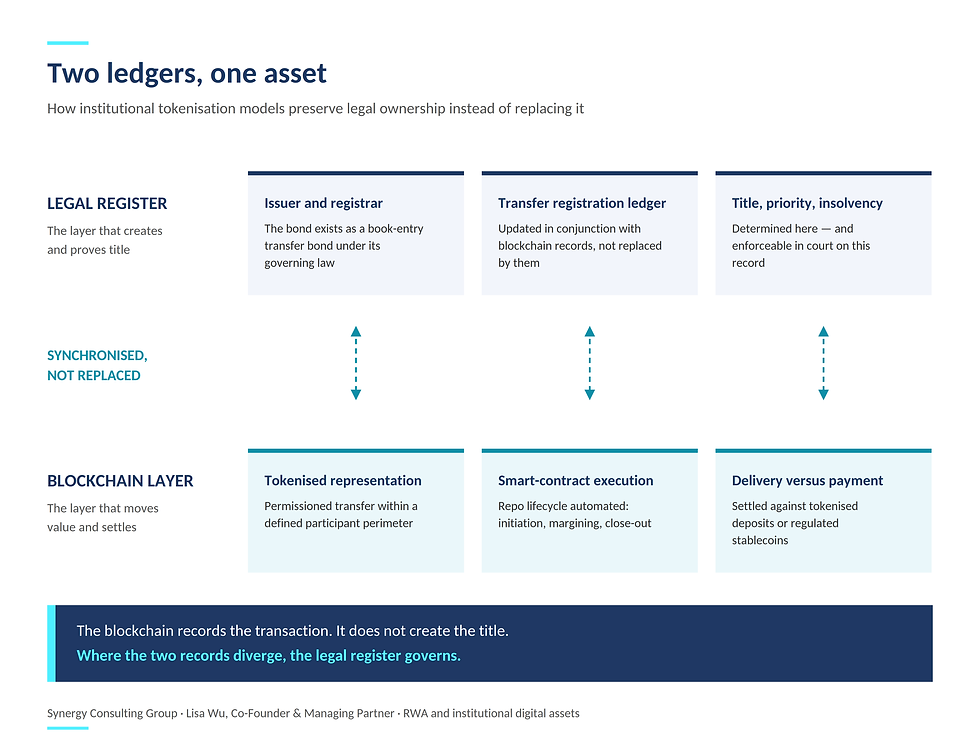
Financial assets are legally enforceable rights. Those rights must remain intelligible through insolvency, disputes, operational or technology failures, custodian changes, enforcement actions and cross-border transactions. A smart contract can automate execution; it cannot by itself resolve questions of title, insolvency priority, governing law or settlement finality.
This is why serious institutional tokenisation models preserve traditional legal ownership systems and use blockchain as an additional transaction or settlement layer. The MUFG proof-of-concept is instructive: the proposed model maintains the legal nature of JGBs as book-entry transfer bonds, updating the transfer registration ledger in conjunction with blockchain records rather than replacing it.
The documentation layer is being built in parallel. ICMA published the Digital Assets Annex to the Global Master Repurchase Agreement in August 2024, providing standardised terms for repo transactions involving digital cash, digital securities including tokenised traditional securities, and asset-backed digital assets. On 30 April 2026, ICMA published the Digital Bonds Annex, extending the GMRA framework to natively-issued digital debt securities whose terms envisage the use of distributed ledger technology. ICMA's 2026 GMRA legal opinion update extended Digital Assets Annex coverage to eight jurisdictions, including
Hong Kong.
That progression matters. For regulated institutions, adoption depends heavily on enforceability, close-out netting, documentation, operational controls and regulatory capital treatment. The expansion of standard documentation and legal-opinion coverage for digital assets is an important signal that the market infrastructure around tokenised collateral is maturing.
Technology should strengthen a financial asset's legal infrastructure, not create uncertainty around it.
Asia is building the institutional settlement layer now
The infrastructure question is not theoretical in Asia, and it is not confined to Japan.
In Hong Kong, the Hong Kong Monetary Authority launched EnsembleTX on 13 November 2025, moving Project Ensemble from sandbox experimentation into a real-value pilot. Participating banks and market participants can settle tokenised assets against tokenised deposits on a delivery-versus-payment basis, with interbank settlement initially facilitated through the HKD Real Time Gross Settlement system and the environment progressively upgraded toward settlement in tokenised central bank money. EnsembleTX is running throughout 2026, with an initial focus on tokenised money market fund transactions and real-time liquidity and treasury management.
The Securities and Futures Commission is a key partner in that work. On 20 April 2026, the SFC launched a framework to pilot secondary trading of tokenised SFC-authorised investment products in Hong Kong, principally to facilitate secondary trading of tokenised SFC-authorised open-ended funds on SFC-licensed virtual asset trading platforms, with safeguards covering pricing, orderly trading, liquidity and disclosure.
Across Hong Kong, Singapore and Japan, institutional tokenisation initiatives increasingly show similar design patterns: preserving or clearly defining legal ownership, combining tokenised assets with a credible digital cash leg, applying institutional-grade controls, and developing documentation and regulatory frameworks around the technology. Singapore's Project Guardian, for example, has included work on digital bonds, repo facilities and secured borrowing and lending involving tokenised bonds and deposits. Offshore jurisdictions such as the British Virgin Islands and the Cayman Islands may continue to be used for issuer, fund and holding-company structures, but the relationship between those vehicles and the onshore regulated layer is a substantive structuring question rather than an administrative one.

The SCG Institutional Usability Test
Many real-world-asset projects begin by asking: how do we tokenise the asset? At SCG we find a four-layer test more productive, because it maps to what an institutional counterparty will actually ask in diligence.

Legal integrity → Financeability → Settlement → Institutional controls
A tokenised asset becomes institutional financial infrastructure only when it can satisfy all four. Each layer resolves into a small number of concrete questions.
Layer 1 — Legal integrity
Who owns the asset, what rights the token represents, which record is authoritative, and what regulated activity the arrangement creates.
Who legally owns the underlying asset, under which jurisdiction's law, and which record is legally authoritative?
What rights does the token holder actually receive — proprietary, contractual, economic, or none of these?
Can those rights survive issuer insolvency, and is there genuine bankruptcy remoteness or only the appearance of it?
What regulated activities arise around the transaction — securities, funds, payments, custody, deposit-taking, e-money — as distinct from the token itself?
Layer 2 — Financeability
Whether the asset can be pledged, financed or used as collateral, and whether those interests are enforceable and reliably valued.
Can it be used as collateral, and would a secured party's interest be perfected and enforceable?
How is it valued, by whom, and what happens when the valuation source fails or is manipulated?
How is it redeemed, against whom, and does that redemption claim create a regulated liability?
Layer 3 — Settlement
How the cash leg works, when settlement becomes final, and whether delivery-versus-payment can operate reliably across the relevant systems and jurisdictions.
When does settlement become legally final, and what happens if the blockchain state, custodian records and legal register diverge?
What happens when counterparties sit in different jurisdictions with conflicting characterisation rules?
Layer 4 — Institutional controls
Custody, identity, permissioning, confidentiality, auditability, interoperability and operational resilience.
Who holds the asset, and is that custodian regulated, independent and segregated from the issuer?
Can the token be transferred, to whom, and what happens at the perimeter of any whitelist?
In our experience working with RWA, stablecoin and digital-asset infrastructure clients, insolvency protection, collateral enforceability and settlement mechanics are the issues most likely to surface when an institutional counterparty begins diligence — and they are materially harder to fix late in a project.
The next competitive advantage is institutional usability
The first generation of digital-asset businesses competed on blockchain architecture and token design.
The next generation will compete on institutional usability: systems that can satisfy the requirements of financial institutions, institutional investors, regulators, custodians, auditors, banks, exchanges and sophisticated counterparties without asking those participants to abandon the legal and risk controls on which capital markets depend.
The most successful digital asset infrastructure may be the infrastructure that makes blockchain feel least exotic to those institutions.
The distinction is simple enough to state in a line. Issuance is representation. Collateral, repo and settlement are financing. Tokenisation remains important, but for institutional RWA and digital securities, issuance is increasingly the starting point rather than the end state.
The next phase will be defined by whether those assets can be financed, pledged, transferred and settled with the same legal certainty and operational confidence institutions expect from traditional capital markets. That is the point at which tokenisation stops being a technology proposition and starts becoming financial infrastructure.
Working on an RWA, tokenised securities or institutional digital-asset project? SCG supports new and existing structuring mandates across Hong Kong, Singapore, the BVI, the Cayman Islands and the UAE. Get in touch at contact@synergyconsulting.io.
Disclosure: Secured Finance is an SCG client. SCG is not a participant in the MUFG proof-of-concept; references to that project are based on publicly available information.
Disclaimer: General information only; not legal, tax, investment or financial advice. Synergy Consulting Group is a consultancy, not a law firm. Regulatory positions are stated as at 1 September 2026 and may change.
